| |
Yoga
Remedies
Yoga
Remedies >> Diabetes
Dhanurasan
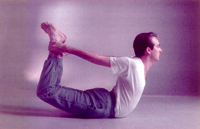 When this asan is performed, it gives the appearance of a bow. Dhanur means a bow. The stretched hands and legs represent the string of a bow, the body and thighs represent the bow proper.
Method: Lie prone on a blanket on the floor. Relax the muscles. Now bend the legs over the thighs. Firmly hold the right ankle with the right hand and the left ankle with the left hand. Raise the head, body and knees by tugging at the legs with the hands, so that the whole burden of the body rests on the abdomen and the spine is nicely arched backwards like a bow. Maintain the pose for a few seconds and then relax the body. Even a weak person can perform this asan easily. To perform this asan, a sudden movement of the body is required. Be steady. Never jerk the body. This asan is a combination of Bhujangasan and Shalabhasan with the addition of catching the ankles. Shalabhasan, Dhanurasan, and Bhujangasan form a combination.
These form one set of asans. Dhanurasan should be repeated 3 to 4 times.
Effects: All benefits of Shalabhasan and Bhujangasan are derived from Dhanurasan. The back muscles get a good massage, it helps remove constipation, cures gastro-intestinal disorders, energises digestion, invigorates appetite, relieves congestion of blood in abdominal viscera and insulin slowly begins to be formed and starts flowing out.
Dhanurasan is a difficult asan and many people cannot do it easily. Particularly those who are fat find it hard to master it. An alternative to this asan is the Nabhiasan.
|





